

Placed in service is a tax date—not necessarily the closing date.
Placed in service bonus depreciation analysis for a net lease acquisition begins with the calendar. The right question is whether the property and its components were ready and available for their intended income-producing use.
Placed in service bonus depreciation does not turn on the closing date alone. A signed purchase agreement, a funded closing, tenant possession, and a placed-in-service date can be four different events. That distinction matters because depreciation generally begins when property is placed in service, and the special depreciation allowance applies only in the first year eligible property is placed in service.
The IRS describes property as placed in service when it is “ready and available” for a specific use. In a net lease acquisition, that standard requires a fact-based review. A buyer should not assume that the deed date answers every timing question, especially when construction, tenant improvements, equipment installation, licensing, casualty repairs, or a lease commencement remains outstanding.
The practical takeaway: establish the intended income-producing use, identify what had to occur before the asset was ready for that use, and retain contemporaneous records supporting when those conditions were satisfied.
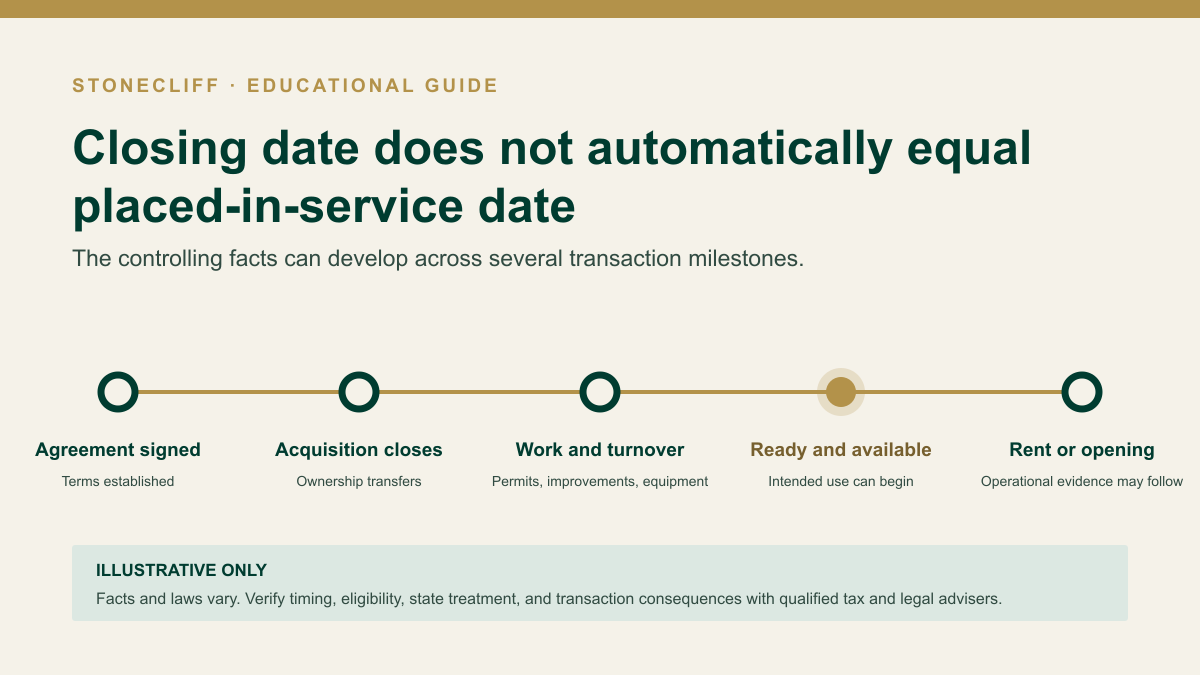
Closing is evidence. It is not always the whole answer.
A stabilized, occupied single-tenant property acquired with an existing lease may present a relatively straightforward record: the tenant is operating, rent is accruing, and the property is available to produce income when the buyer acquires it. Even then, the taxpayer’s advisers should confirm the applicable date and review how each depreciable asset is classified.
The analysis becomes less straightforward when the property cannot yet perform its intended function. Consider a buyer that closes on a vacant quick-service restaurant while a new tenant’s buildout is incomplete. Ownership has transferred, but the facts may not support the same placed-in-service conclusion as an occupied, rent-producing restaurant. The certificate of occupancy, lease terms, turnover documents, construction completion, equipment readiness, and marketing or leasing activity may all be relevant.
Placed-in-service timing also operates at the asset level. A building, later capital improvement, and newly installed equipment do not necessarily share one date. The IRS notes that an improvement is treated as separate depreciable property. A buyer completing parking-lot work or installing qualifying equipment after acquisition should preserve costs and completion evidence by project rather than blending everything into one unsupported date.
Placed-in-service records for bonus depreciation
The strongest process is built during diligence and closing, not reconstructed at tax-return time.
Placed-in-service diligence checklist
Five files to assemble before tax-return preparation begins.
Educational framework only · Verify the facts and tax treatment with qualified tax and legal advisers.
Three common net lease timing patterns
| Property facts | Records worth preserving | Question for advisers |
|---|---|---|
| Occupied property with an existing tenant and rent stream | Lease, estoppel, rent ledger, closing statement, tenant-operation evidence | Was the income-producing property ready and available at acquisition, and which components are eligible? |
| Vacant property being marketed without major work | Listing agreement, marketing launch, property condition, access and utility records | When was it genuinely ready and available to rent, rather than merely held for future work? |
| Property requiring renovation, tenant work, licensing, or equipment installation | Construction schedule, permits, certificate of occupancy, tenant acceptance, equipment commissioning | Did the building and separate improvements enter service on different dates? |
These are decision frameworks, not conclusions. Similar-looking transactions can receive different treatment because lease economics, property condition, construction responsibility, asset ownership, and taxpayer elections vary.
Placed in service bonus depreciation: why timing matters
A placed in service bonus depreciation review starts by testing acquisition timing and asset readiness separately. It then connects those facts to each asset’s classification and the taxpayer’s circumstances.
Current IRS instructions explain that certain qualified property acquired and placed in service after January 19, 2025 may be eligible for a 100% special depreciation allowance. The instructions also contain transition rules for certain property acquired earlier. Acquisition timing and placed-in-service timing therefore need to be tested separately.
Bonus depreciation generally applies to eligible shorter-life property—not land or the ordinary 39-year structural portion of a commercial building. A cost segregation analysis may identify qualifying 5-, 7-, or 15-year components, but the classification, basis, acquisition requirements, placed-in-service date, and taxpayer-level limitations must all be reviewed before a deduction is claimed.
A large first-year deduction can also create a mismatch between the tax schedule and economic expectations. Rental losses may be passive, states may decouple from federal rules, and accelerated deductions may affect recapture when an asset is sold. If a 1031 exchange is part of the exit plan, exchange basis and asset-level recapture should be modeled with the investor’s qualified advisers.
Questions to ask before closing
- Is the tenant open and paying rent, or are lease and rent commencement still contingent?
- Will any required work, permit, inspection, license, or equipment installation remain incomplete at closing?
- Who owns tenant-installed equipment and improvements under the lease?
- Which improvements will the buyer fund after acquisition, and how will costs and completion dates be tracked?
- Does the transaction include used property, related parties, or a prior ownership relationship requiring additional review?
- Does the investor expect to use resulting losses, and does the relevant state conform to federal bonus depreciation?
- How could accelerated deductions affect recapture or a planned disposition?
The brokerage role
Stonecliff is a commercial real estate brokerage, not a tax or engineering adviser. Our role is to help buyers evaluate the real estate: lease structure, tenant credit, property condition, transaction timing, market position, and the records available from the seller. Those property-level facts can give the buyer’s CPA, attorney, and cost-segregation professional a better starting point.
For a broader explanation of eligibility, property classes, passive-loss limits, state treatment, and exit considerations, read Stonecliff’s bonus depreciation guide for commercial real estate investors.
Important tax and legal disclosure
Stonecliff Real Estate is a commercial real estate brokerage and does not provide tax, legal, accounting, engineering, or cost-segregation advice. This article is general educational information, is not taxpayer-specific advice, and is not a promise of any tax result. Facts and laws vary. Before acquiring, improving, leasing, exchanging, or selling property—or claiming any deduction—readers should verify eligibility, calculations, acquisition and placed-in-service timing, state conformity, passive-loss treatment, depreciation recapture, elections, documentation, and transaction consequences with their own qualified tax and legal advisers.
Primary sources: IRS Publication 946, How To Depreciate Property and IRS Instructions for Form 4562.
Evaluate the property facts before the tax calendar takes over.
Stonecliff helps net lease buyers source opportunities, understand lease and property risk, and organize transaction information for their independent advisers.
