

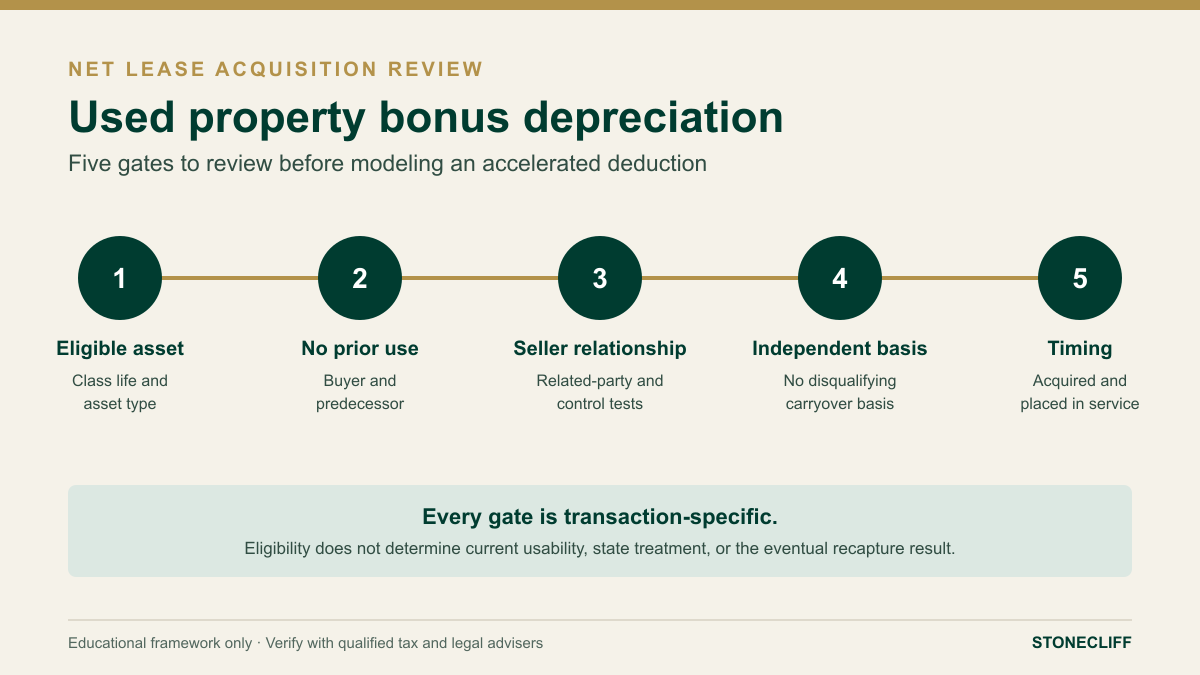
Used Property Bonus Depreciation: A Net Lease Acquisition Guide
Used property can qualify for bonus depreciation—but “used” is only the beginning. For a net lease acquisition, eligibility depends on the asset, the buyer’s prior relationship to it, the seller relationship, basis rules, acquisition timing, and when the property is placed in service.
Used property bonus depreciation is possible under federal law. A buyer does not necessarily need to acquire newly manufactured equipment or a newly constructed building. But the rule is not a blanket deduction for the full purchase price of an existing net lease property.
The ordinary 39-year structural portion of nonresidential real property and land generally do not become bonus-eligible merely because ownership changes. The analysis usually focuses on qualifying shorter-life components identified through defensible basis allocation and, where appropriate, a qualified cost segregation analysis.
The practical takeaway: separate two questions. First, which acquired assets are the type of property that may qualify? Second, does the specific acquisition satisfy the used-property and timing requirements?
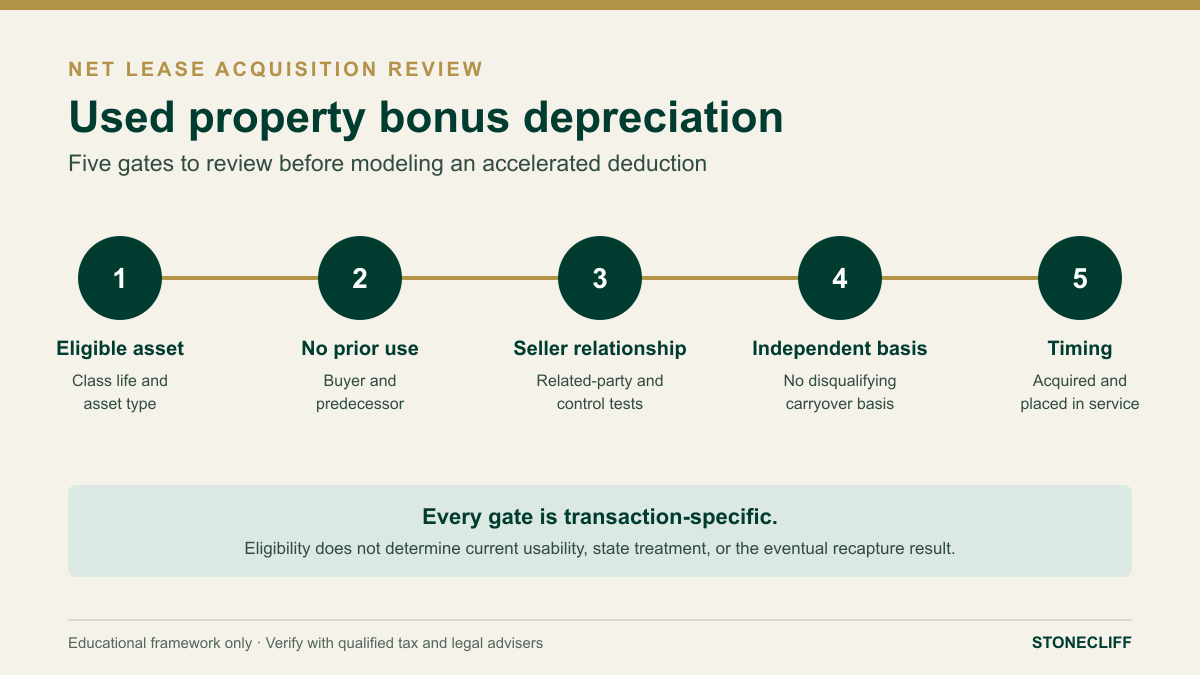
Five acquisition gates for used property bonus depreciation
Current IRS guidance explains that used property must satisfy several acquisition requirements in addition to the general bonus-depreciation rules. For a net lease buyer, the following framework turns those technical rules into diligence questions.
Eligible asset type
Confirm that the asset is qualified property—generally property with a MACRS recovery period of 20 years or less or another specifically eligible category—not land or the ordinary structural building basis.
No disqualifying prior use
The buyer or a predecessor generally must not have used the property before acquiring it. Prior leasing, ownership, or a depreciable interest can require close analysis.
Seller relationship
Property acquired from a related party or certain members of a controlled group may fail the used-property acquisition requirements.
Independent cost basis
The buyer’s basis generally cannot be determined in whole or in part by reference to the seller’s adjusted basis or certain inherited-property rules.
Acquired and placed in service
Apply the current acquisition-date rules and establish when each asset was ready and available for its intended income-producing use.
Why an existing net lease property is not one asset
A purchase agreement may describe one parcel and one price, but federal depreciation works at the asset level. The transaction can include land, a 39-year building, land improvements, equipment, furniture, signage, specialized systems, and other components with different recovery periods and eligibility.
A cost segregation study can help classify qualifying components and allocate depreciable basis. It cannot cure an acquisition that fails the used-property rules, create basis that the buyer does not have, determine whether losses are currently usable, or replace the buyer’s CPA and legal analysis.
| Acquisition fact | Why it matters | Records to preserve |
|---|---|---|
| Asset purchase from an unrelated seller | May support the related-party and independent-basis tests, but does not establish asset eligibility by itself. | Purchase agreement, closing statement, ownership representations, entity chart, basis allocation. |
| Buyer or affiliate previously leased or used the property | Prior use or a prior depreciable interest may affect the no-prior-use requirement. | Prior leases, options, operating agreements, ownership history, placed-in-service records. |
| Related-party transfer, partnership restructuring, or entity acquisition | Special rules can apply to related parties, partnerships, consolidated groups, predecessors, and transaction series. | Entity ownership before and after closing, tax basis schedules, transaction steps, adviser memorandum. |
| 1031 exchange or involuntary conversion | Carryover and excess basis can require separate asset-level treatment rather than one assumed bonus amount. | Exchange documents, relinquished-property schedules, replacement-property allocation, closing statements. |
Used property bonus depreciation timing: acquisition and placed in service are separate
The 2025 Form 4562 instructions state that Public Law 119-21 reinstated a 100% special depreciation allowance for certain qualified property acquired and placed in service after January 19, 2025. The instructions also contain transition rules for property acquired earlier.
IRS interim guidance published in Internal Revenue Bulletin 2026-06 instructs taxpayers to apply rules consistent with Treasury Regulations section 1.168(k)-2, with updated dates and modifications, when determining eligibility for property acquired after January 19, 2025. A signed letter of intent, binding purchase agreement, closing, tenant possession, and placed-in-service date can be different events.
For an occupied acquisition, the facts may support a straightforward placed-in-service analysis. A vacant or renovated property may require evidence about construction completion, permits, tenant turnover, marketing, equipment commissioning, and readiness for income-producing use.
Three assumptions that deserve extra scrutiny
“The seller already depreciated it, so the buyer cannot.”
That is too broad. Federal law can permit qualifying used property, but the new buyer must satisfy the acquisition requirements and establish its own depreciable basis and placed-in-service facts.
“The whole purchase price gets 100% bonus depreciation.”
No. Land is not depreciable, and the ordinary structural portion of a commercial building generally has a 39-year recovery period. Only eligible assets within the buyer’s properly allocated depreciable basis may qualify.
“A projected deduction automatically reduces this year’s tax bill.”
Eligibility is not the same as current usability. Passive-loss, at-risk, business-use, entity-level, state-conformity, and other limitations may defer or change the effect. Review the distinction in Stonecliff’s guide to whether real estate bonus depreciation can offset W-2 income.
Questions for the buyer’s advisers
- Which specific assets are being acquired, and what supports their basis and class life?
- Did the buyer, a predecessor, partner, affiliate, or controlled-group member previously use or hold a depreciable interest in any asset?
- Are buyer and seller related under the applicable federal rules?
- Is any basis determined by reference to the seller’s basis, inherited-property rules, exchanged property, or another carryover mechanism?
- When was the binding acquisition commitment made, and when was each asset placed in service?
- Does the ownership entity have elections or partnership-level adjustments to consider?
- Will passive-loss, at-risk, state-conformity, or other rules limit current use?
- How could accelerated deductions affect depreciation recapture on a later sale?
A better underwriting method for used property bonus depreciation
Underwrite the property before underwriting the tax result. Start with rent, tenant credit, lease obligations, capital needs, location, financing, and exit assumptions. Then add a separately labeled federal and state tax scenario reviewed by the investor’s qualified professionals.
The most useful diligence package connects the purchase agreement, entity chart, closing statement, prior-use history, improvement records, placed-in-service evidence, cost segregation work, federal fixed-asset schedule, and state adjustment schedules. That record is more durable than a headline deduction percentage.
The brokerage role
Stonecliff is a commercial real estate brokerage, not a CPA, law firm, engineering firm, or cost-segregation provider. We help net lease investors evaluate real estate fundamentals and organize transaction facts for their independent advisers. For the broader framework, see Stonecliff’s net lease bonus depreciation guide.
Important tax and legal disclosure
Stonecliff Real Estate is a commercial real estate brokerage and does not provide tax, legal, accounting, engineering, or cost-segregation advice. This article is general educational information, is not taxpayer-specific advice, and does not promise any tax result. Federal and state facts and laws vary and can change. Before acquiring, improving, leasing, exchanging, selling, filing a return, or claiming any deduction, readers should verify asset eligibility, basis allocation, calculations, acquisition and placed-in-service timing, prior use, related-party status, state conformity, passive-loss and at-risk treatment, depreciation recapture, elections, documentation, and transaction consequences with their own qualified tax and legal advisers.
Primary sources reviewed: IRS Instructions for Form 4562; IRS Bonus Depreciation FAQ; IRS Internal Revenue Bulletin 2026-06; and IRS Publication 946.
Evaluate the real estate—and give the tax team a clean acquisition record.
Stonecliff helps investors source and evaluate net lease opportunities while organizing the property and transaction facts their qualified advisers need.
