

Bonus depreciation by state: one federal deduction, multiple state outcomes.
For net lease investors, a federal bonus depreciation estimate is only the first layer. State conformity can change the timing, reporting, and economic value of the deduction.
Bonus depreciation by state is not uniform. A net lease investor may qualify for a federal special depreciation allowance while receiving a different result on one or more state returns. Some states follow the current federal rule, some tie their tax code to an earlier version of federal law, and others require an addition modification or reject federal bonus depreciation altogether.
That difference does not necessarily mean the underlying cost disappears for state purposes. Depending on the jurisdiction and taxpayer, the state may require a current-year addback, allow different depreciation over time, or use another adjustment mechanism. The correct treatment can also vary by entity type, tax year, ownership structure, and where income is apportioned.
The practical takeaway: model federal and state depreciation separately before treating a projected first-year federal deduction as a transaction-level cash-flow benefit.
Why state conformity changes the analysis
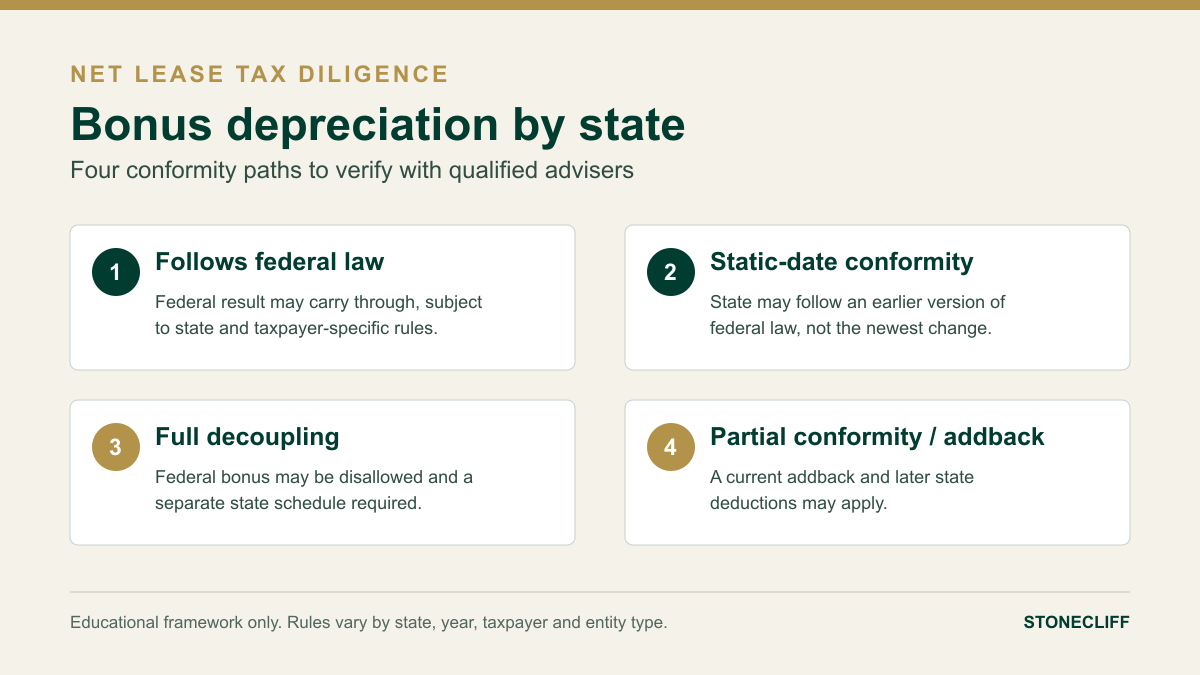
Federal taxable income is often the starting point for a state return, but each state decides how closely it follows the Internal Revenue Code. A state with rolling conformity may generally adopt federal changes automatically. A static-date state may follow the federal code only as of a specified date. A decoupled state may specifically disallow the federal bonus provision, while a partially conforming state may require an addback or other adjustment.
These are useful planning categories, not permanent labels. Legislatures update conformity dates, enact selective exceptions, and revise addback or recovery rules. A current map can be a helpful screening tool, but the controlling state statute, return instructions, and revenue-department guidance should govern the final analysis.
Follows federal law
The state may begin with the federal result, subject to state-specific limitations and taxpayer rules.
Static-date conformity
The state may conform to an earlier version of the Internal Revenue Code and not automatically adopt a later federal change.
Full decoupling
The state may disallow the federal special depreciation allowance and require a separate state depreciation schedule.
Partial conformity or addback
The state may require some federal deduction to be added back, sometimes with later state deductions under separate rules.
Current examples show why a 50-state shortcut is risky
The IRS instructions for Form 4562 explain the federal special depreciation allowance and reflect federal legislation reinstating a 100% allowance for certain qualified property acquired and placed in service after January 19, 2025, subject to detailed eligibility and transition rules. That federal rule does not compel every state to produce the same return result.
| Example | What current state guidance says | Investor diligence implication |
|---|---|---|
| California | The California Franchise Tax Board states that California personal income tax does not conform to federal bonus depreciation. Its corporate-law summary also describes nonconformity to IRC Section 168 generally. | Do not carry a federal deduction into a California model without a California-specific fixed-asset and return analysis. |
| New York | Current New York instructions explain that New York generally does not follow federal depreciation rules for IRC Section 168(k) property placed in service after May 31, 2003, subject to stated exceptions. | Confirm the applicable New York addition and subtraction modifications, taxpayer type, and property facts with the return preparer. |
| North Carolina | The North Carolina Department of Revenue states that the state did not adopt federal bonus depreciation under Sections 168(k) or 168(n) for property placed in service during tax year 2025 and requires an 85% addback. | A federal model may overstate the immediate state deduction; review both the addback and any later state recovery schedule. |
These examples are snapshots, not a complete survey. They demonstrate why the property state alone is not enough. An investor owning properties through partnerships or other entities in multiple jurisdictions may need to consider entity-level rules, owner residence, apportionment, composite returns, and state-specific elections.
A two-schedule framework for net lease acquisitions
A useful diligence process maintains two connected views of the same acquisition:
- Federal fixed-asset schedule. Separate land, the building, land improvements, equipment, and other components; document basis, class life, acquisition date, and placed-in-service timing.
- State adjustment schedule. For every filing jurisdiction, identify the applicable conformity date or decoupling rule, additions, later subtractions, elections, and carryforward tracking.
A cost segregation analysis may identify shorter-life components that could be eligible federally, but it does not decide whether a particular state follows the same treatment. The study, federal tax return, and state workpapers should reconcile rather than operate as unrelated files.
Illustrative transaction: the deduction timing can diverge
Assume an investor acquires an occupied net lease property and a qualified professional identifies eligible shorter-life components. If the federal eligibility, acquisition, and placed-in-service requirements are satisfied, the federal schedule may reflect a special depreciation allowance. A state that decouples may instead require the federal amount to be added back and depreciated under its own rules.
This example does not estimate a taxpayer’s deduction. The amount that can actually affect a return also depends on basis allocation, asset classification, related-party and prior-use rules, elections, business-use requirements, passive-loss limitations, at-risk rules, state law, and the taxpayer’s other facts.
Questions for the tax team before closing
- Which federal and state returns will the owner and ownership entity file?
- Does each jurisdiction use rolling, static-date, selective, or decoupled conformity for the relevant tax year?
- Is an addition modification required, and how are later state deductions tracked?
- Do the rules differ for individuals, partnerships, S corporations, C corporations, or other owners?
- How will a cost segregation study feed both federal and state fixed-asset schedules?
- Can projected losses be used currently after passive-loss and at-risk limitations?
- How may state differences affect depreciation recapture, a taxable sale, or a planned 1031 exchange?
- What records should be retained to support basis, classification, timing, and state adjustments?
What this means for underwriting
Bonus depreciation should be presented as a separately verified tax scenario—not as guaranteed property income. An acquisition model can show the real estate economics first, then layer in federal and state tax scenarios prepared or reviewed by the investor’s qualified advisers. This keeps cap rate, rent growth, tenant credit, lease obligations, financing, and exit assumptions distinct from taxpayer-specific benefits.
For the broader federal framework, see Stonecliff’s bonus depreciation guide for commercial real estate investors. Investors should also review how accelerated deductions may affect depreciation recapture when property is sold.
The brokerage role
Stonecliff is a commercial real estate brokerage, not a tax, legal, accounting, engineering, or cost-segregation provider. We help investors evaluate the real estate and organize transaction facts—property location, ownership structure, lease terms, improvement history, pricing, timing, and potential exit paths—for review by their independent advisers.
Important tax and legal disclosure
Stonecliff Real Estate is a commercial real estate brokerage and does not provide tax, legal, accounting, engineering, or cost-segregation advice. This article is general educational information, is not taxpayer-specific advice, and does not promise any tax result. Federal and state facts and laws vary and can change. Before acquiring, improving, leasing, exchanging, selling, filing a return, or claiming any deduction, readers should verify eligibility, calculations, acquisition and placed-in-service timing, state conformity and modifications, passive-loss and at-risk treatment, depreciation recapture, elections, documentation, and transaction consequences with their own qualified tax and legal advisers.
Sources reviewed: IRS Instructions for Form 4562; California FTB Summary of Federal Income Tax Changes; New York Form IT-225 instructions; North Carolina DOR bonus depreciation adjustment guidance; and the Tax Foundation state conformity overview as a secondary screening reference.
Start with durable real estate economics. Then test the tax scenarios.
Stonecliff helps buyers source and evaluate net lease opportunities while organizing the transaction facts their qualified advisers need.
